

Unbalanced combat is cool
Expanding tactical variety

This article contains affiliate links, using them incurs no cost to you.In Quinns’ review of Chris McDowall’s Mythic Bastionland, Quinns asks for encounter balancing advice. In the OSR/NSR zone of the hobby, we often talk about how combat balance isn’t something to aim for.
There’s lots of reasons folks give for this (it’s not a new topic), but I’m going to come at it from the following angle: aiming for balance restricts the kinds of tactical situations and moral dilemmas you create at the table when violence happens. It restricts the probability space.
Fights that are ‘too hard’
We’re talking about encounters where defeating the opposition is either:
Going to incur significant losses of some kind like PC deaths, NPC deaths, expenditure of critical resources, or permanent injuries.
Outright impossible to achieve.
Why is this good? It forces your party to focus on survival or to decide what they are willing to sacrifice.
If your party decide to retreat, now you have a gripping chase sequence as they flee from opposition that’s gonna chew them up if they don’t get away. This can be especially fun if combat is ongoing and attacks are being thrown back and forth along the way. You also have a persistent foe…
If defeating these opponents is really important, this becomes an interesting choice for players. Perhaps an NPC the party cares about is being held hostage by stronger opposition. Do they take the risk anyway, knowing at least some of them will likely be killed?
Take a look at the Golseeper, from the Inkvein Quickstart Guide (which you can grab here).
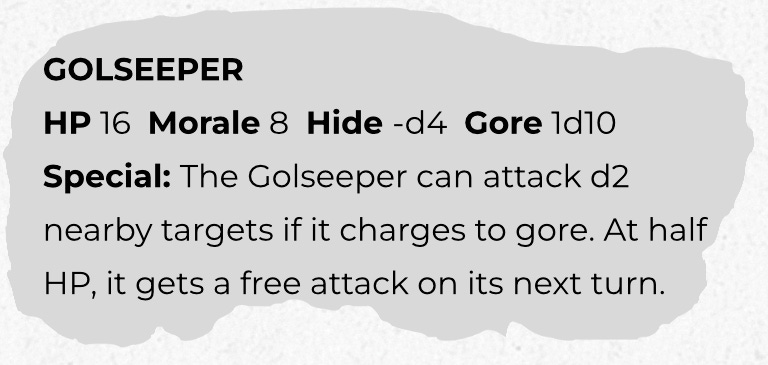
In Mörk Borg terms, this thing is a potential nightmare for fresh characters. It’s got a ton of HP, good armour, and its attack might even 1-shot a couple of of PCs.
But there’s a few things that make this interesting.
First is that this creature gives players a chance to walk away: “If a creature behaves aggressively towards the Golseeper, it first lets forth a bellow as a warning, then mercilessly fights if the warning is not heeded.”
The other thing is that the danger this thing presents is telegraphed: “…a hulking four-legged Ink-thing, a Golseeper: broad and triangular skulled like a giant salamander, eyeless, tail-less, with long digits. It moves the rubble, too heavy for a human, at an agonising pace.” It moving the rubble flags its incredible strength.
This creature acts more like a trap. If the PCs set the trap off, they likely want to get out of dodge and a PC might die for the party’s error.
Fights that are ‘too easy’
In contrast, there can be encounters where the opposition will struggle to pose a significant threat to the party. This is interesting because:
The party has a lot of decision making power. Do they slaughter everyone? Do they capture the opposition? This plays into the party’s reputation and speaks to their morality.
The party doesn’t necessarily know that a fight will be easy. It can actually keep them on their toes to have combat not always be tough and keep them guessing. It feels more real.
It makes combat a more valid option in terms of risk, which provides players with variety in their decision making process and a variety of situations.
By comparison to the Golseeper, the thief Sykri is little threat for a reasonably sized party.
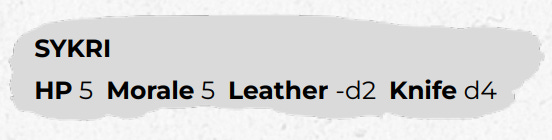
And that’s interesting, because Sykri is searching for the location of a stash of loot. If the PCs help her find it, it would be all too easy to gut her and cut out her share of the loot. But whether they do that or not is an interesting question.
No balance doesn’t mean ‘unfair’
I think there’s often a misconception about what ‘don’t balance things’ means. No OSR/NSR GM is putting a group of level 1 PCs up against 2d6 adult red dragons unless they explicitly have the idea that a non-combat solution is the focus.
A GM wants to present challenges that clever players can overcome, not just mash PCs into the ground constantly.
What it really means is: combat is not a test you can assume you have a good chance of winning, nor a good chance of losing. Which is to say, that vs. the playstyles of grid-based tactical combat games or some trad/neo-trad games, the probability space of situations is typically much wider.
This isn’t a better way to play, but it demonstrates how removing balance in combat broadens the probability space. Which for many of us, is a positive feature!
So Chris, please never put encounter balancing guides in your books.
Hi, thanks for sharing your thoughts on"balancing". That's exactly the misunderstanding: not balanced = unfair. I myself prefer adventures where I don't know the outcome of a fight in advance. It keeps me thinking of alternatives: parley, run away, try to talk my way out of the situation, try not to get in such a situation in the first place. :)
There are adventures where losing the fight makes the ending much more interesting. I had one of those where we failed to stop a ritual to turn a captured angel into a fallen angel. It triggered a chain of events that changed the entire setting.