

TO WAR!
Step-dice mass-combat system

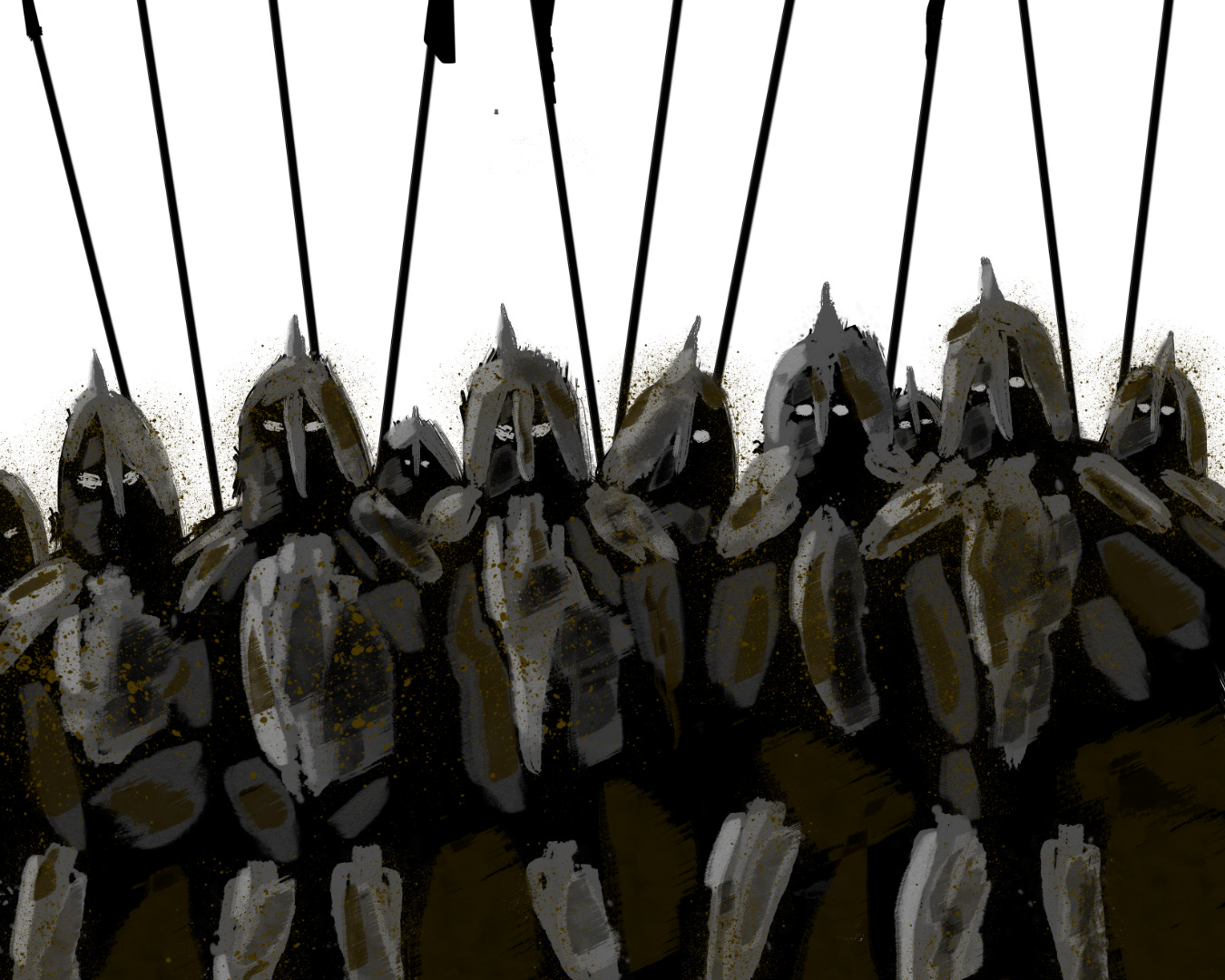
I have often found that mass combat rules have either a) failed to scale to different sizes of conflict or b) got too crunchy for me. So, as Murk must, I made my own.
There are a few systems (which I recommend) that inspired me:
Into the Odd. Detachments are real neat, this game is just a must-own.
The Symbaroum GMG. For understanding that mass combat should feel like war.
Forbidden Lands. The origin of my obsession with step dice.
These are the mass combat rules I developed for the end of a 3 year campaign where thousands of combatants clashed in a bloody dark fantasy showdown. I tested them with over 15+ hours of play time in a 25+ location pointcrawl warzone, with over 30 units. I can report they worked very well in play.
MurkMail Premium subscribers had the draft of these rules months ago! To get access to my fledgling design thoughts, try MurkMail Premium today.
Some assumptions:
You don’t care about rulers and grid style combat. You settle on a standard base movement distance for units (a group of combatants). Pick whatever suits the scale of the space and the timescale you want your conflict to work with.
Units have two actions, as in many OSR/NSR games. A main action (attack, move, interact, something else) and a move action. These can be used in any order.
Units
Units have a power die and tags.
Power die: This dictates general combat ability, not necessarily numbers. Bigger is more powerful. It ranges from d4 to d20. The power die is rolled to resolve conflicts and also tracks the strength of the unit.
Set a power scale according to the scale of your conflict. For a small skirmish, a d4 might be a small squad of militia. For a war, a d4 might be an entire detachment of soldiers.
Tags: Anything important about their skills and behaviours (see below).
Splitting and Combining Units: A unit may be split by dividing its power die. The total value of the split dice need to equal the original e.g. d20 can be split into two d10 units. Likewise two d10 units of the same type can be combined into a d20.
Tags
Create tags as you require for your setting and style of warfare. I used these ones for my dark fantasy war. I recommend no more than ten.
Ranged: Can fight effectively at range.
Fast: Can move double distance per turn.
Slow: Must spend both actions to move.
Siege: Can damage structures effectively.
Bulwark: Can defend well if given time to dig in.
Covert: Effective at moving undetected.
Mystic: Can use or defend against magic.
Unyielding: Cannot be forced to retreat.
Opposition
When two units oppose each other, they roll their power dice. If greater power is advantageous (e.g. open combat), the highest roll wins. If lesser power is an advantage (e.g. avoiding detection), the lowest roll wins. If a unit has a relevant tag (or other factors suggest so), advantage or disadvantage can be imposed on these rolls.

Violence
Where one unit seeks to harm another, the losing side decreases their power die by one. If their power die is a d4 and they lose in a violent confrontation the unit is either a) wiped out, b) entirely captured, or c) scattered (up to the victor).
The losing side, if they are alive and free after the attack, rolls a morale check. They roll their new power die. If they roll a 1, they are forced to retreat to safety (unless they have the Unyielding tag).
If multiple units attack one unit, they all roll and the best result counts. If the single unit wins, they decide which opposition unit is harmed. If the opposition to a unit is overwhelming, the GM can rule that no roll is needed and annihilation occurs.
Initiative
Alternate between the players and the GM, where on each turn they prescribe a set of orders to their units. The orders can be as simple or as complex as the commanders desire, and orders can apply to as many turns as the commanders wish e.g. guard this location until ordered otherwise.
Recovery
Units only regain steps of their power die if fresh troops are provided. They do not heal naturally over time.
That’s it?
Yep. And it works a treat:
It’s scalable to any conflict size.
Units are described through a single step die and some tags, which keep them simple but give some uniqueness.
Combat is simple and quick, with morale being meaningful and easy.
Give it a try!
Nice simple rules to keep things moving. Scalable is a nice feature, too.
When I try mass combat, I will have to give this a try.
Sounds easy enough, I’ll have to give it a try, but what about including heroes/characters? Would you do something like SD Hell March?