

Step-dice rumour tables
Osmosis of intelligence

When I wrote the rumour table for the city above the Inkvein, I didn’t think too much of it. But then my editor (hey Lyndsay) left a note saying that the step-dice mechanism in the table is pretty neat.
I’m sure someone has done this before but I haven’t seen any articles or videos on it so I figured I’d share this technique: the step-dice rumour table.
Basic concept
The idea is simple. You make a table of rumours but rather than rolling on the whole thing, you begin by rolling a smaller die on it. Take the Inkvein rumour table: it’s got 20 entries (so it can scale to d20) but begins on a d4.
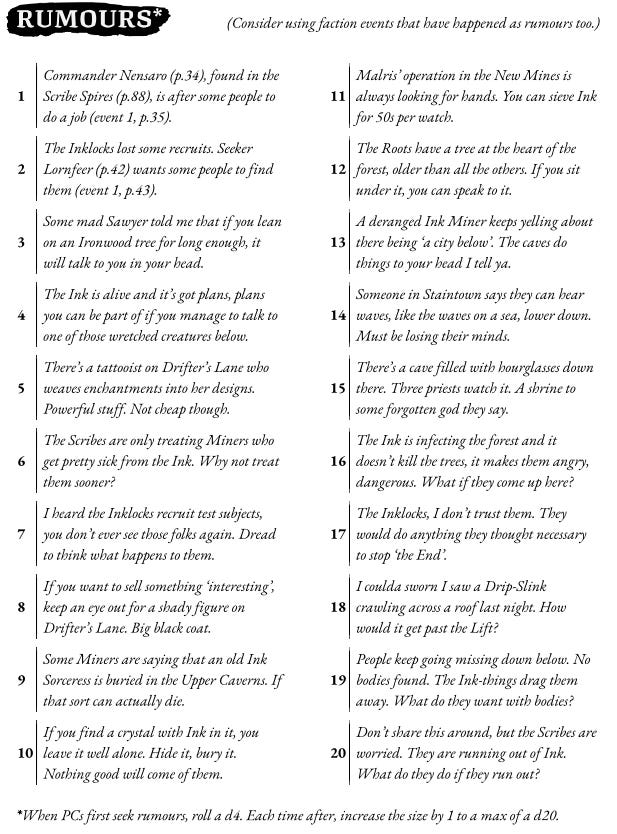
You don’t have to go this big. Depending on the size of your adventure, something like an 8 entry table using a d4 → d6 → d8 chain is probably going to be the sweet spot for most.
In Inkvein, the dice size increases each time the party ask for rumours (typically something that’s going to happen days apart). But you don’t have to do it that way.
You could use fixed time periods as a reason to increase die size e.g. increasing it once per in-game week. Or you could use the increasing die size as a kind of ‘social score’ that the PCs have with the community that they are trying to get rumours from.
So. Why do we do this?
Osmosis
If all intelligence is available at once, it feels kind of weird. With games that are centred around exploration, we’re assuming the PCs are one of the few people who are looking around an uncharted space. If all rumours are possible up front, that means one of two things.
Either the rumours only cover the easy to access portions of the ‘exploration-zone’. This shouldn’t hold true as time goes on: NPCs and creatures should be looking around as time progresses.
Or… the rumours cover more of the ‘exploration-zone’ than they really should. They don’t reflect how unexplored the space should be.
We can mitigate this by gating rumours about harder-to-reach locations behind the step dice chain. It takes time for those rumours to come into play.
This simulates how information naturally spreads in communities, allowing the communities that PCs are trying to get rumours from to feel more realistic in how their knowledge changes over time.
Curation
Structuring our rumour tables like this allows us to be quite intentional about how we hand out information. The first d4 hooks in Inkvein are each a way or hints as to how to get in touch with a faction. That’s no accident.
Rather than giving some vague hint about a secret deep down in the dungeon, Inkvein starts off with clear gameplay hooks that give players a way to get immediately stuck in. But the table quickly branches out into more ambiguous information that is easier to action when the players actually know the setting a bit better!
Updates are a key idea
Inkvein also prompts GMs to replace spent entries with faction events (of which there are a possible 40) as a way to distribute diegetic information about what might be happening on the bigger scale of things.
Wrap-up
The step-dice gets maxed out after a few uses, but it does a critical job in the earlier portion of a game:
It simulates the natural gathering of information in the community, reflecting the low number of people going into the ‘exploration zone’.
It curates intelligence for players to make the start of the game a bit easier but also rewards their mastery of the setting as things open up.
Next time you’re gearing up to run a setting, consider using a step-dice rumour table (or multiple of them!).
As someone that's fallen in love with step dice systems to the point I've been slowly kitbashing my own game together, I've never actually considered using it for a rumor table.
My favorite part of this table: the rumors go physically deeper on the page as players descend deeper into the cave. That's some art-game synergy.