

Encounter Remix Table
An encounter refresh tool

This article contains affiliate links, meaning I get a commission if you make purchases using these links, at no cost to you.A short while back, I published my event sequences in encounter tables idea, where encounter tables have sequences of events that connect together.
Some folks responded that they wanted a way to ‘remix’ an encounter instead of writing sequences or just more encounters. You asked, you get.
Typical procedure
Let’s take a traditional encounter table, like these horrors from Sean McCoy‘s Mothership’s Dead Planet (an excellent module):
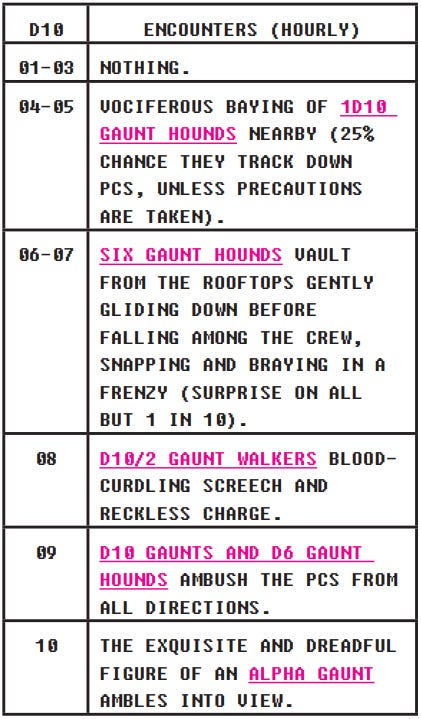
Entries contain a few extra details beyond the creatures, but something like this is a great starting point.
So, when we re-roll one of these entries, do we need to change it up?
In a typical location-based adventure, there are some factors that cause variation in encounters:
Location. Normally, we are in a different location if the same encounter entry comes up again (because ya know, probability). This gives some environmental variety.
Reaction rolls. This can give us a different dynamic to before, if we’re using reaction rolls.
Awareness. If we are rolling to see which sides are aware of each other, this creates some tactical differences.
Our own judgement. We can always improvise ways to change things up.
What if we want more variation to chew on?
Encounter Remix Table (d12)
When you re-roll an encounter, roll on this to get some extra inspo.
1: Omen. The encounter is indirect: a warning, clue, or other indicator is present that foreshadows the real deal.
2: Double up. Roll on the encounter table again and combine. If how they would interact is unclear, roll a d6. 1-2: In conflict; 3-4: Neutral; 5-6: Collaborating.
3: Gathering. The creatures are harvesting some kind of resource in the location.
4: Seeking. The creatures are searching for something they have yet to find.
5: Resting. The creatures are resting. If they are intelligent, have they set a watch?
6: Deliberating. The creatures are discussing their next course of action. If there is only one creature, portray internal debate through body language.
7: Injured. The creatures are dealing with harm of some kind.
8: Fleeing. The creatures are retreating from something.
9: Crafting. The creatures are making something. Even a cognitively simple creature can be making something e.g. digging a hole.
10: Trap. The creatures have set a trap or ambush of some kind. Roll a d6. 1-2: It’s for the party; 3-4: It’s for someone else; 5-6: It’s for anyone.
11: Panic or frenzy. The creatures are behaving erratically.
12: Destroying. The creatures are working to destroy something.

Practice time
Let’s take entry 8 from Mothership’s Dead Planet, d10/2 gaunt walkers. We roll it a second time and want to change things up.
We roll on the remix table and get a 7. Injured.
Some possibilities are:
If one of the gaunt walkers got away with wounds last time, that gaunt walker is licking a pulse-rifle wound that our players dealt it.
The walkers were attacked by the gaunt alpha after they failed to submit to it. Describe the wounds on the gault walkers to foreshadow the gaunt alpha.
Maybe another group in the area had a fight with these creatures. If the party crosses paths with them, maybe they have useful combat tactics to share (or alternatively regale their own horror story).
I’m sure you can come up with three differents ones too. Next time you need to freshen up an encounter, grab this table.
You can also combine this with my Reaction Table Overhaul to give encounters a better idea of why a creature is doing something.
PAYWALL BREAK ALERT: Want more random table analysis? We have a partial paywall break on one of our MurkMail Premium articles! Go read my essay about different types of random tables.