

Adventure design is about negative space
Choosing what not to include

A quick note before we get started, I was on a podcast this week! I chatted with the lovely Todd from Sabre Games about all things megadungeons, blogging, and some stuff about the old-school community. You can check it out here.
Let’s attempt to imagine a ‘perfect’ module. Every detail of the adventure space is provided. Every action that players could take is covered by a decision tree and if-then clauses. And this would make for a very bad game.
It would leave little point in having a GM who would fill gaps in an adventure with their unique rulings and choices.
What’s the point of this thought experiment? It helps us understand that the space an adventure leaves for the GM to fill is just as important as what is stated, it’s what allows the GM and the players to make the game theirs.
Adventure design is as much about negative space as it is about what we detail. Legwork is good, but the areas we leave empty for the GM to fill are just as important and define how a GM interacts with a module.
Useful vs. tricky negative spaces
Some negative spaces are harder to work with. Imagine an extreme example: I give you the room descriptions of a dungeon but I omit the map. “That’s your job! Have fun!” Now if you relish the idea of making a map and plugging all the room descriptions in, maybe that’s good negative space. But for many, it isn’t.
Of course, maybe what you get given instead is a procedure to generate the map. That’s exactly how a depthcrawl works and they are really neat!
However, there are plenty of times where negative space works well. In fact, it’s critical to let a GM and the players use their creativity and make their mark on the game. Let’s look at a dungeon key from an adventure as an example.
This is a key from Tephrotic Nightmares:
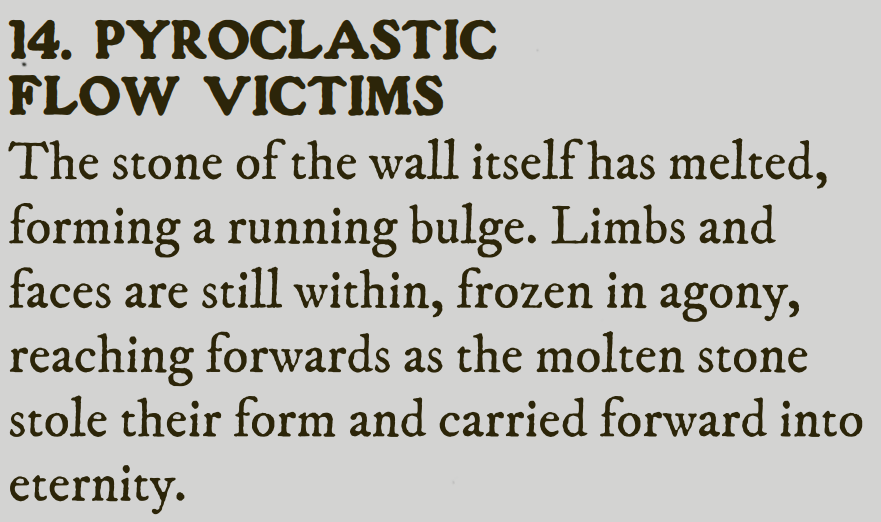
Let’s think about some details that this key doesn’t include:
How many people are part of this wall?
How big is this wall?
Not including these are invitations for the GM to twist the space into something they find evocative. One GM might imagine the wall as being tall, with a long row of victims that are beyond counting. Another might imagine something more intimate, a small and low wall with less than a dozen victims.
It is interesting how a GM would choose to interpret this. It gives them space to impart their touch onto the adventure. This also speaks to our preferences as GMs: what negative space do we like?
Even in module design where a lot of detail is typical (think AD&D modules, megadungeons like Arden Vul, or Call of Cthulhu scenarios), there is usually some negative space for the GM to shape.
Inkvein example
Here’s a sub-dungeon room with a short key from Inkvein.
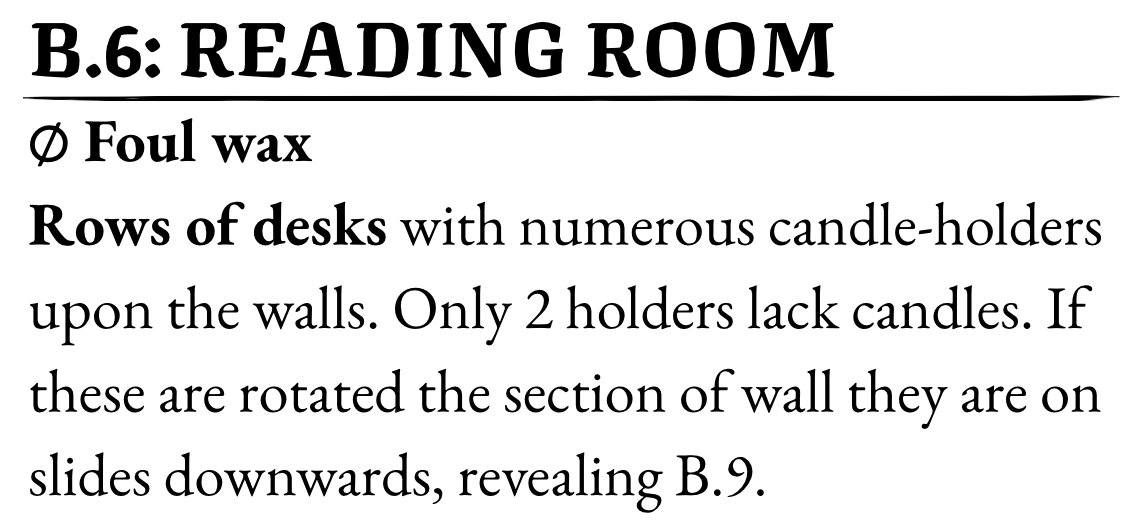
A detail I omit is what is in the desks of the reading room. I could put a loot table in this chamber for the desks, or maybe just suggest the contents of the desks, but I decided not to. Why?
Because it’s cool to see what the GM would imagine is in the desks. Especially when the desks are in a creepy basement. Do they imagine bundles of quills? Or perhaps something stranger, like draws full of charcoal powder?
It’s a detail that isn’t of importance to the dungeon design, the naturalism of the space, or the overall feeling of the location. It wasn’t important to add some specific environmental storytelling here either. Instead, it becomes an opportunity for the GM to add their personal flavour, and make the Inkvein theirs.
Even as the writer of Inkvein, improvising an answer to this question excites me because it’s an opportunity for me to add more vibes in the moment.
You can expect all the key details mapped out for you in Inkvein (all the game-y connective tissue), but also breathing room so GMs can add their own flavour. Take a look at the quickstart guide (free) on our BackerKit page for a taste.
Negative spaces are opportunities
If you’re running a module, negative space is a chance for your table to take some ownership of the space, to make it yours. When I’m shopping for adventures, I’m often thinking about whether it gives me interesting gaps to fill as much as I am about whether it gives me a good foundation to run a game.
For homebrew prep, thinking about negative space helps us understand what not to prepare. What kind of questions are we interested in answering in the moment? Those are things we can skip in prep and tackle in session.
I’ve been thinking about this issue a lot recently. I’ve been writing a lot of oracle and spark tables for the system I’m developing. In the end I have scrapped a lot of it because it was too descriptive and ended up feeling like a straight jacket for creativity. New versions of the results are much more sparse. I just didn’t have the right terminology of “negative space”, but that is the perfect vocabulary for it
Totally agree! And ideally we design in dynamic interactable things rather than inert and unchangeable things. Stored potential energy. Precarious but promising situations.
I actually cap off atmosphere building by asking the players to reveal something left in negative space. Last night, "What makes this reed hut in the swamp seem especially witchy?" It always creates a good moment and draws intense player interest.